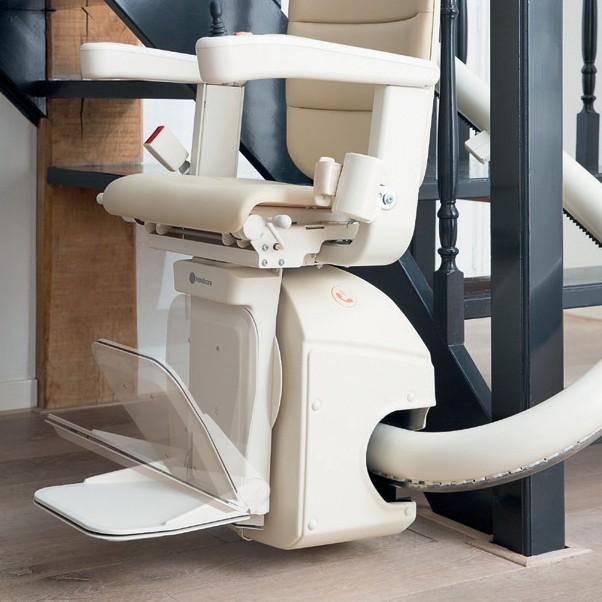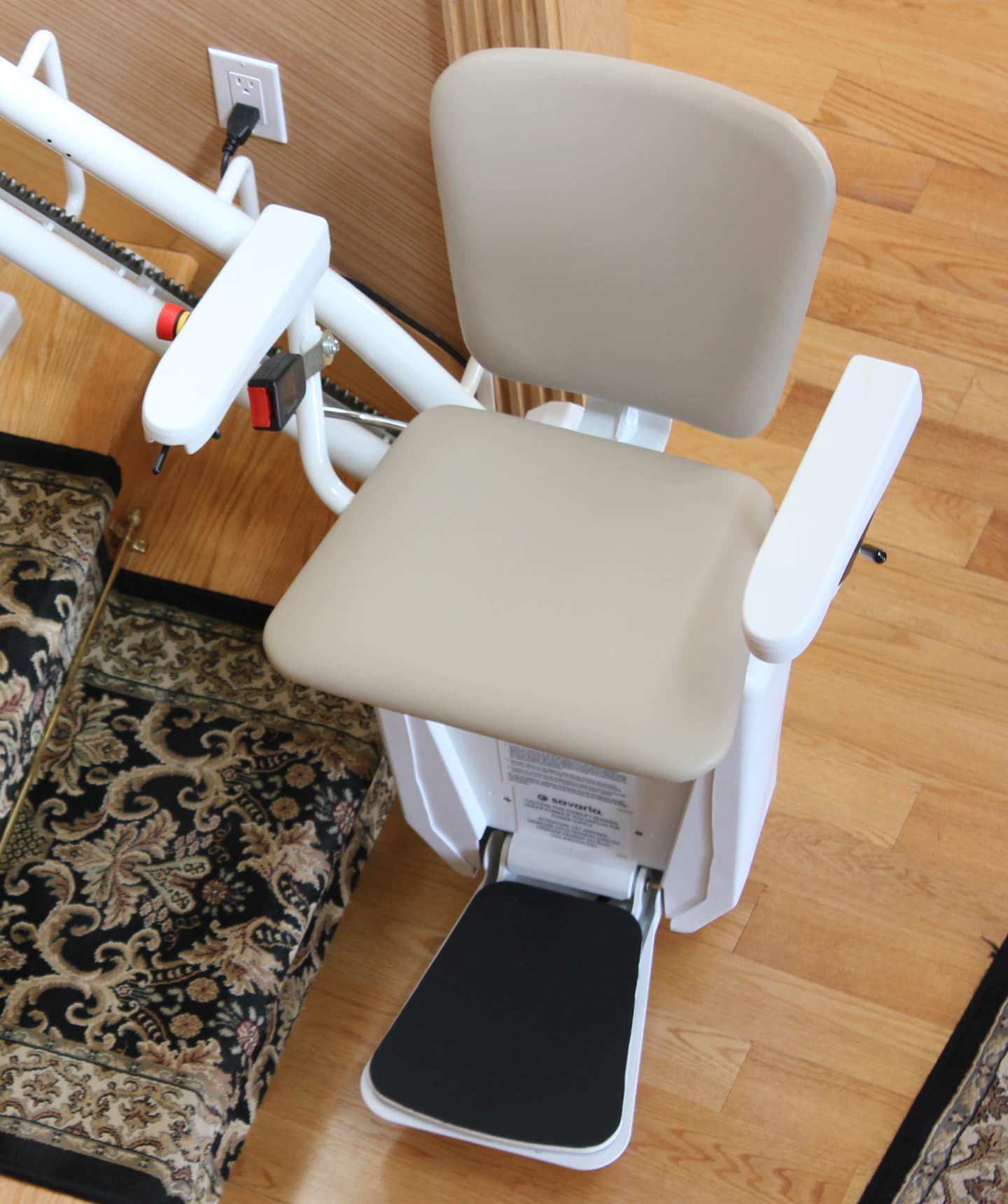

Stairlifts for Disabled Adults & Wheelchair Users
A seated stairlift carries a person up and down stairs on a chair attached to a rail. Whether it is a practical choice depends on the person’s seating, transfer and control needs as well as the staircase—not simply their age or diagnosis.
The Stairlift Store helps households in selected Greater Toronto and Hamilton Area communities, excluding Toronto, explore seated-stairlift options. Tell us the installation address when requesting a free, no-obligation assessment.
Can a wheelchair user use a stairlift?
A wheelchair user may be able to use a seated stairlift if they can transfer safely onto and off the seat at both ends and use the chair with the support they need. A standard seated stairlift does not carry the wheelchair. When the person needs to remain in their wheelchair during travel, a wheelchair platform lift or another wheelchair-carrying solution needs consideration instead.
Transfers may be independent or assisted, but having someone available to help does not by itself establish that the arrangement will work. The space, seat position and assistance needed must be considered at both landings.
There must also be a suitable way to move around after leaving the stairlift. A second wheelchair or another appropriate mobility aid may be needed on the other floor. Do not assume a folding or travel chair can replace prescribed seating or the person’s usual support.
Where transfers or seating are difficult, involve an occupational therapist or another appropriate health professional familiar with the person’s needs. An assessment of transfers, posture and wheelchair support addresses different questions from an installer’s assessment of the staircase.
Stairlift or Wheelchair Lift: What Travels Between Floors?
The names can be confusing. Compare how the equipment works and whether the wheelchair travels with its user.
| Equipment | What Travels? | Route | What Needs Checking? |
|---|---|---|---|
| Seated stairlift | The person rides on the stairlift seat; the wheelchair stays behind. | A chair follows a rail along the stairs. | Transfers at both ends, seating and controls, and mobility equipment on each floor. |
| Inclined platform lift | The person remains in their wheelchair on a platform. | The platform follows the staircase. | Wheelchair dimensions, rated load, stair clearance, landing access and the proposed rail route. |
| Vertical platform lift | The person remains in their wheelchair on a platform. | The platform moves vertically between levels rather than following the stairs. | The lift’s footprint, travel height, entry and exit space, and the installation work required. |
Manufacturers distinguish inclined and vertical wheelchair platforms as separate options. Neither is simply an attachment that converts an ordinary stairlift chair into a wheelchair carrier. For either platform type, check the wheelchair’s dimensions and the combined load of the person, wheelchair and anything else permitted to travel. Learn more about wheelchair lift types.
Portable stair-climbing equipment is another category. A compatible device, staircase and operator arrangement need their own assessment; a portable product is not automatically a substitute for a permanent home lift. See an example of portable stair-climbing equipment.
The Stairlift Store can discuss seated-stairlift options. For wheelchair-carrying equipment, ask a provider of that equipment to assess the proposed device and route; the comparison above is not a list of products available from our store.
Check the Whole Journey, Not Just the Staircase
Picture a complete trip: approaching the lift, getting onto it, travelling, getting off and continuing to the next room. Include the person who will use the equipment and anyone who normally assists them.
Use these questions to prepare for an assessment—not as a test that confirms suitability.
| Part of the Journey | Questions to Discuss |
|---|---|
| Getting on and off at both ends | Can the wheelchair reach the proposed seat position? Is there space for the transfer and any assessed assistance? Does a nearby door interfere? |
| Sitting and using the controls | Does the seat provide the required support? Can the person reach and operate the controls, restraint and swivel mechanism, or is an appropriate alternative needed? |
| Moving around on each floor | What wheelchair or mobility aid will be available after the ride? Does it meet the person’s needs, and can they reach the rooms they need to use? |
| Sharing the home | Where will the chair and rail park? How will other household members use the stairs, doors and landing while the equipment is parked and in use? |
| Assistance and changing needs | Who will provide any assessed help, and when? Would the arrangement still be practical on a difficult day or if the person’s needs change? |
For example, a chair that fits the staircase still may not provide a workable journey if the upper landing cannot accommodate the wheelchair or the necessary assistance. A manual or powered wheelchair label alone does not answer those questions.
Straight, curved and outdoor stairlift options
A straight stairlift follows one uninterrupted straight flight. A curved stairlift is considered when the rail must continue around a bend, turn or intermediate landing.
Where two straight flights meet, two separate lifts would introduce another change of chair and movement across the landing. That additional transfer needs consideration alongside the price and available space; it should not be treated as equivalent to one continuous ride.
For exterior steps, outdoor stairlifts use models intended for that setting. The proposed model, exposure and access at each end must be assessed.
There is no single stair-width figure that confirms every installation. Folded width describes parked equipment; it does not establish room for the seated person’s knees and feet or for transfers at the landings. Our guide to stairlift width and landing clearance explains the different measurements.
Which stairlift features should you compare?
Choose features around the person’s actual use of the lift. Ask which functions are standard, which are optional and which are available on the unit being quoted.
Seat position, swivel and support
Check the proposed seat height, available adjustments, armrests, foot support and weight capacity. Discuss how the seat turns and locks at the landing and whether the user can operate that mechanism. A powered feature does not replace an assessment of transfer or seating needs.
Controls and folding functions
Compare the reach and operation of the travel controls, call/send controls and folding parts. A folding footrest is not necessarily power-operated, and powered footrests do not establish that the armrests also fold automatically.
For a concrete example, Savaria lists a powered seat swivel and powered folding footrest as options for the Handicare Freecurve. Confirm the exact configuration and availability rather than assuming every Freecurve or every stairlift includes them.
Parking, restraints and day-to-day use
Ask where the chair will stop and park, whether the rail affects a doorway, and whether a compatible folding rail or different parking position is available. Have the provider explain the restraint, obstruction sensors, stopping controls and any key-operated access fitted to the proposed model.
Also ask where the lift charges and what operation to expect during a power cut. Follow the model’s instructions; do not assume an unlimited number of battery-powered trips. Our guide to using a stairlift provides general operating context, not instructions for an individual wheelchair transfer.
What affects the installed price?
Our stairlift price guide gives general planning ranges of CAD $2,000–$5,000+ installed for straight stairlifts and CAD $10,000–$15,000+ installed for curved stairlifts. These are category ranges, not a quote for every user, model or configuration, and they are not wheelchair-platform-lift prices.
The rail, staircase, model, condition and selected options affect the final cost. Pre-owned stairlifts or rentals may be worth discussing where suitable equipment is available, but lower cost does not resolve a transfer or seating problem.
Ask for a written quote identifying the unit and rail, installation, chosen options, any additional work and the warranty and service coverage. Confirm whether taxes and other charges are included. Compare quotes for the same requirements rather than comparing a basic chair price with a complete installed solution.
See the stairlift price guide for the detailed cost comparison and estimator.
Questions families often ask
Does Ontario’s Assistive Devices Program pay for a stairlift?
No. Ontario lists stair lifts among the equipment its Assistive Devices Program does not cover. Do not assume funding for a wheelchair also covers a stairlift. For any other program or private insurance policy, check the exact equipment, eligibility and approval requirements before relying on financial support. Ontario Assistive Devices Program.
Can a caregiver ride with the user?
Do not plan for a caregiver to share the stairlift seat. Acorn’s published safety guidance specifically limits its stairlifts to one occupant. Assistance at a landing is different from riding together; the assistance arrangement and the selected model’s instructions need to be considered before purchase. Acorn Stairlifts safety guidance.
Is a stairlift suitable for every disabled person?
No. Disability or age alone does not establish suitability. The equipment has to work for the person’s transfers, sitting, controls and daily routine, as well as the home. When a seated journey is not appropriate, another access arrangement may need consideration.

Discuss your home with The Stairlift Store
The Stairlift Store has 30+ years in business and 1,000+ stairlift installations across the GTA. Speak with Mark about the staircase, the seating and control functions you need to discuss, and any assessment advice you already have.
We serve selected Greater Toronto and Hamilton Area communities, excluding Toronto. Share the installation address and whether the stairs are straight, turn or include an intermediate landing so we can confirm coverage and discuss a suitable next step.